
A WEST COAST HEALTH LAW SERIES
The False Claims Act in Healthcare
What Every Practice Owner Must Know Before It's Too Late
The False Claims Act (FCA) is the federal government's most powerful tool against healthcare fraud — and it doesn't require intent to defraud to ruin a practice. In fiscal year 2025, the Department of Justice recovered a record $6.8 billion under the FCA, and roughly 84% of it came from the healthcare industry. This three-part series explains what the law is, how ordinary practices get caught in it, and the concrete steps you can take to protect yours.
PART 1 OF 3
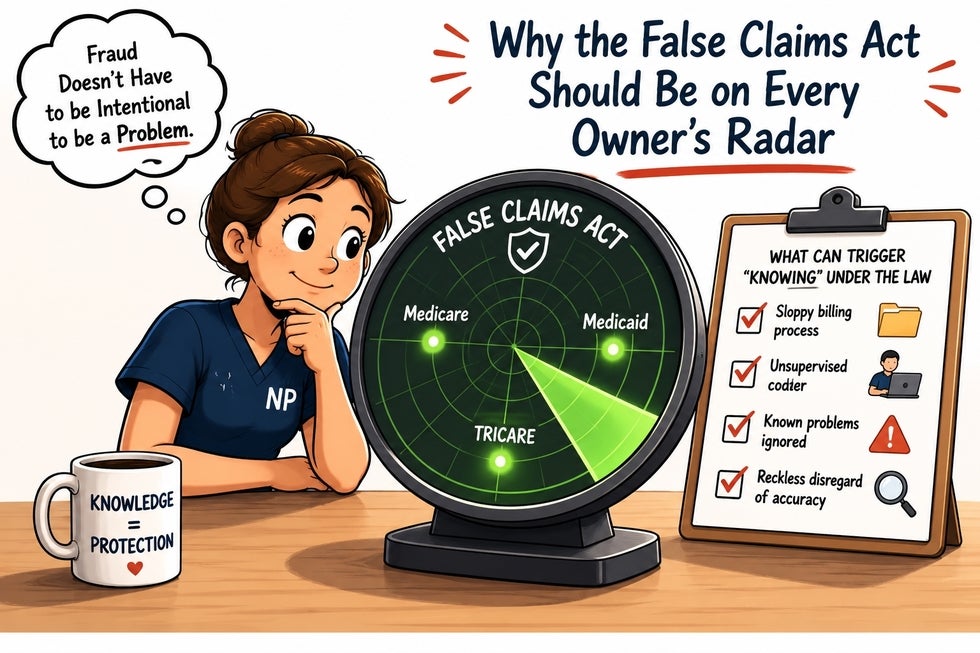
Why the False Claims Act Should Be on Every Owner's Radar
The False Claims Act prohibits knowingly submitting — or causing the submission of — false or fraudulent claims for payment to federal programs such as Medicare, Medicaid, and TRICARE. For any practice that bills government payers, this is the single most consequential fraud statute in the country.
The word that trips up most owners is “knowingly.” It does not mean a deliberate scheme to steal. Under the statute, “knowing” includes acting in deliberate ignorance or reckless disregard of whether a claim is true. In practice, a sloppy billing process, a coder left unsupervised, or a refusal to investigate known problems can all meet the standard. Intent to defraud is not required.
The penalties are severe — and they multiply
Liability under the FCA has two punishing components. First, the government can recover treble (triple) the actual damages it sustained. Second, a separate civil penalty attaches to each individual false claim — each line item, not each patient or each year.
For 2026, those per-claim penalties range from:
• $14,308 minimum per false claim, to
• $28,618 maximum per false claim.
Because a single course of treatment can generate dozens of claims, penalties compound quickly. A modest billing error repeated across hundreds of patients can produce a demand in the millions — before damages are even tripled.
Whistleblowers drive the cases
Most FCA actions don't start with a government audit. They start with a person. The Act's qui tam provisions let private individuals — usually current or former employees — sue on the government's behalf and share in the recovery. Whistleblower filings hit a record high of 1,297 in FY 2025, and qui tam cases accounted for the large majority of dollars recovered. The disgruntled biller, the departing partner, the nurse who flagged a practice and was ignored: these are the people who most often bring the government to your door.
The takeaway for Part 1 is simple. The FCA is not reserved for criminal masterminds. It is aimed squarely at everyday billing conduct, it carries crushing financial exposure, and the people best positioned to report you are already inside your practice.
West Coast Health Law offers a FREE consultation which you may schedule by clicking the button on our website.

Comments
There are no comments for this post. Be the first and Add your Comment below.
Leave a Comment