
Part 2: Yes, You Can Own It — But It Has to Be a Nursing Corporation
Part 2 of a 3-part series on independent nurse practitioner practice in California.
In Part 1 we established that a 104 NP can legally run an independent practice without a supervising physician. That raises the natural follow-up: whose practice is it, and what can I call it? This is where California's most distinctive health care rule comes in — the Corporate Practice of Medicine doctrine — and where a single wrong choice on your business entity can undo everything.
The good news: California gives nurse practitioners a clean path to 100% ownership. The catch: you have to take the right door, and it is not the door marked “medical corporation.”
The Corporate Practice of Medicine doctrine, briefly
California has one of the strictest and most actively enforced bans on the “corporate practice of medicine” (CPOM) in the country. The core idea is that a clinical profession should be controlled by licensed professionals, not by lay investors or ordinary corporations. The statute is blunt: under Business and Professions Code § 2400, “corporations and other artificial legal entities shall have no professional rights, privileges, or powers.”
Here is the part that matters for you: AB 890 wrote essentially the same language into the 104 NP statute itself. Business and Professions Code § 2837.104(h) provides that, for purposes of independent NP practice, “corporations and other artificial legal entities shall have no professional rights, privileges, or powers.” In other words, the Legislature carried the CPOM principle directly over to independent NPs. You cannot deliver your clinical services through a generic LLC or an ordinary stock corporation, and you cannot hand business or clinical control to non-licensed owners.
Nursing corporation vs. medical corporation
California requires professional services to be delivered through a professional corporation keyed to the license of its owners, under the Moscone-Knox Professional Corporation Act (Corporations Code §§ 13400–13410). There are several flavors, and the differences are not cosmetic.
A medical corporation (Corporations Code § 13401.5) must be physician-controlled: physicians must hold at least 51% of the shares, and non-physician licensees — NPs, PAs, psychologists, and others — together may hold no more than 49%. If you form a medical corporation, you cannot own a controlling stake. This is the source of the persistent “you need a physician to own 51% of your practice” myth.
A nursing corporation (Business and Professions Code § 2775) is the door built for you. Its shareholders, officers, and directors who render professional services must be registered nurses — and because an NP holds an RN license, an NP qualifies. That means a nurse practitioner can wholly own a nursing corporation: up to 100% of the shares, no physician owner required and, in fact, no physician owner permitted in that role.
This distinction — not 104 certification by itself — is what actually makes NP practice ownership work. A useful illustration: the Board of Registered Nursing has noted that a 103 NP working in a nursing corporation cannot practice without standardized procedures, because a nursing corporation is not one of the physician-anchored “group settings” 103 requires. It is precisely 104 status that lets you practice without standardized procedures inside your own nursing corporation. The clinical certification and the corporate structure have to fit together.
What you can — and cannot — call yourself
Because your entity is a nursing corporation and you are a nurse practitioner, your holding-out has to match your license. A few hard lines:
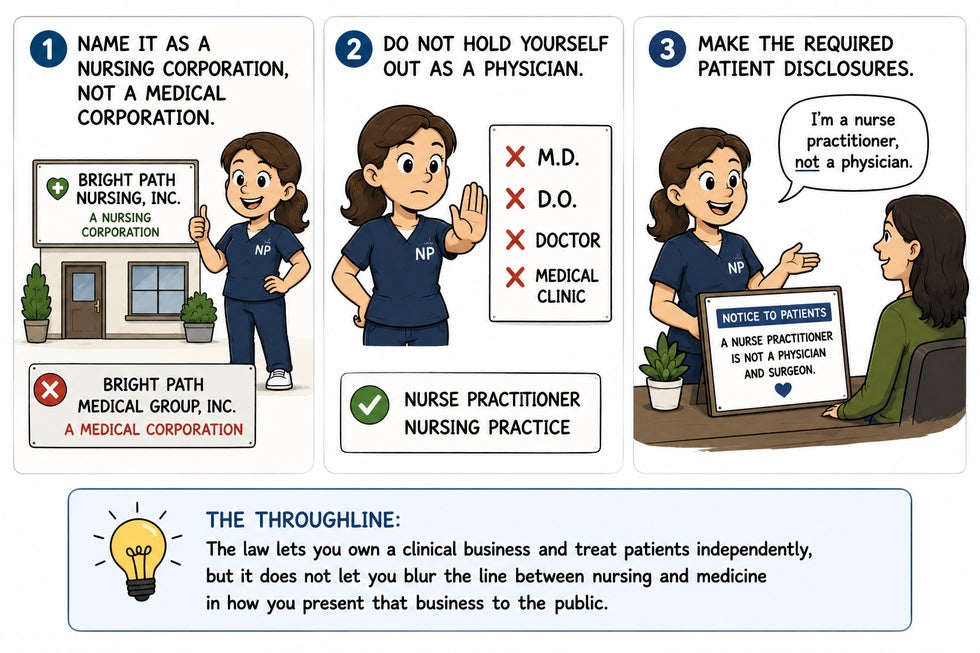
• Name it as a nursing corporation, not a medical corporation. Professional corporations carry naming requirements, and a nursing corporation generally must signal its nature (commonly “A Nursing Corporation” or a Board-permitted equivalent). You may not name or market the entity as a “medical corporation” or “medical group,” which implies physician ownership and the practice of medicine.
• Do not hold yourself out as a physician. California law makes it a misdemeanor for someone not licensed as a physician and surgeon to use titles like “M.D.” or “D.O.” (SB 1451 specifically added “D.O.” to that prohibited list) or otherwise to advertise as practicing medicine. You advertise as a nurse practitioner and a nursing practice — not as a doctor or a medical clinic, even if you hold a doctoral nursing degree.
• Make the required patient disclosures. As covered in Part 1, you must post the Board of Registered Nursing notice and verbally tell new patients that a nurse practitioner is not a physician and surgeon. Your marketing should be consistent with that — accurate about who is treating the patient.
The throughline: the law lets you own a clinical business and treat patients independently, but it does not let you blur the line between nursing and medicine in how you present that business to the public.
The clinical-scope limit doesn't go away
Ownership is not authority to do anything. A 104 NP remains confined to the population focus of their national certification and to the limits of their own education, training, and experience. A psychiatric-mental-health NP cannot quietly run a primary care or aesthetics clinic outside their certification simply because they own the corporation. Build your service lines around your actual certification and competence — not around what the entity could theoretically bill for.
Other statutes that still apply (and a few gray zones)
CPOM and corporate form are the headline constraints, but they are not the only ones. Several adjacent rules apply or remain unsettled because they were written before independent NPs existed:
• Consultation, collaboration, and referral. Section 2837.104(c) still requires you to consult, collaborate, and refer to physicians and other providers based on the patient's clinical condition, including for emergent and complex cases. (Part 3 details this.)
• Prescribing infrastructure. Furnishing/prescribing without standardized procedures, a DEA registration for controlled substances, and CURES (the state prescription-drug monitoring program) all have their own requirements layered on top of your certification.
• Management services organizations (MSOs). Many practices use an MSO to handle administration and bring in capital. These arrangements are legal, but they must be carefully structured to avoid impermissible fee-splitting and CPOM violations — you cannot use an MSO as a backdoor for lay control of the clinical practice.
• Transaction and investment oversight. California's Office of Health Care Affordability material-change-transaction notice rules, and SB 351's limits on private-equity and hedge-fund involvement, were drafted around physician and dental practices and do not squarely address 104 NP practices. That creates both uncertainty and, for now, some flexibility — but it should be navigated with counsel, not assumed away.
• Risk-bearing / capitation. Existing law appears to exclude 104 NP practices from obtaining risk-bearing-organization status, which limits direct capitation arrangements with health plans unless and until the Legislature acts.
• HIPAA and employment law. Any practice that bills third-party payors is subject to HIPAA's Privacy and Security Rules (notice of privacy practices, business associate agreements, safeguards). And as an employer, you take on California's notoriously demanding wage-and-hour and employment obligations.
The bottom line for Part 2
A 104 NP can own a clinical practice outright — but only through a nursing corporation, and only while presenting it honestly as a nursing practice rather than a medical one. The Corporate Practice of Medicine doctrine, the professional-corporation rules, the advertising/title limits, and your own certification scope are the real boundaries of “independence.”
In Part 3, we turn the analysis into a decision and a plan: should you actually open your own practice, what relationship (if any) you still need with a physician, and the concrete steps to launch in compliance.
West Coast Health Law offers a FREE consultation which you may schedule by clicking the button on our website.
This article is for general educational purposes and is not legal advice. CPOM, MSO, and professional-corporation rules are complex and fact-specific, and several statutes referenced here are unsettled as applied to 104 NPs. Consult a qualified California health care attorney before choosing an entity or structuring outside investment.
Key authorities: Cal. Bus. & Prof. Code §§ 2400, 2775, 2837.104; Cal. Corp. Code §§ 13400–13410, 13401.5; SB 1451 (2024); SB 351 (2025).

Comments
There are no comments for this post. Be the first and Add your Comment below.
Leave a Comment