
Planning for the Unplanned: MSOs, Continuity Agreements, and Protecting Your Practice from Sudden Incapacity
Legal Tools for the Events You Hope Will Never Happen — But Must Plan For Anyway
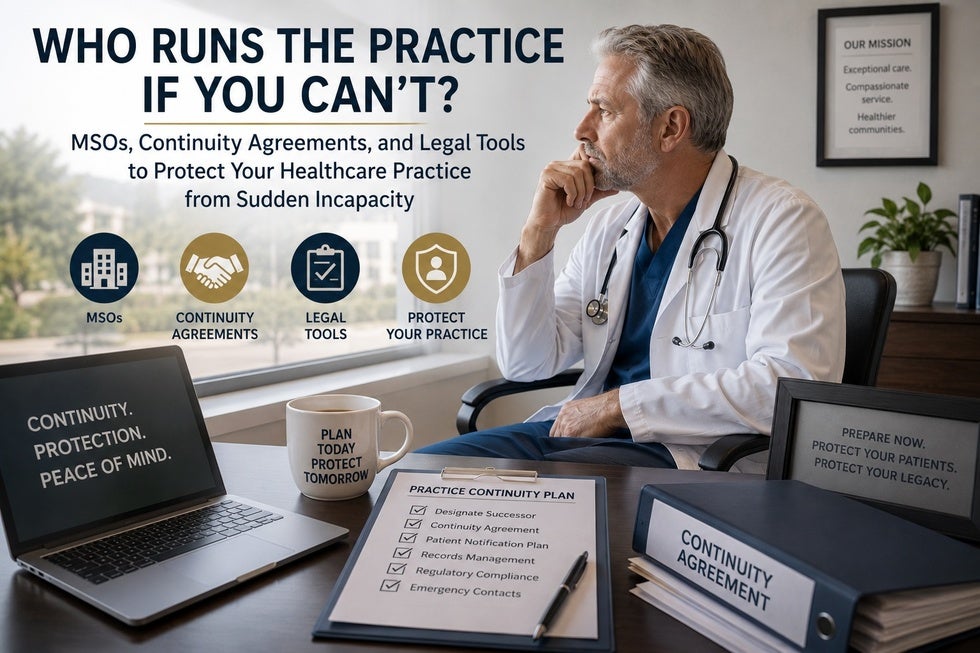
Succession planning is most often discussed in the context of retirement. But the events that most frequently destroy California healthcare practices without warning are not retirements. They are strokes. Car accidents. Sudden diagnoses. A license suspension pending investigation. A mental health crisis. These events do not arrive with sixty days' notice and a transition period. They arrive on a Tuesday morning, and by Thursday, patients are calling to reschedule and staff are wondering whether they still have jobs.
This post addresses the legal tools California healthcare providers use to protect their practices — and the people who depend on them — against sudden, unplanned incapacity or disqualification.
The Durable Power of Attorney for Healthcare Business Matters
The most basic — and most commonly overlooked — succession tool is a properly drafted durable power of attorney (DPOA) that designates a trusted individual to manage the business affairs of the practice in the event of incapacity.
Under California Probate Code Section 4124, a durable power of attorney for finances and business matters remains effective during the principal's incapacity. For a solo practitioner, this means a designated agent can continue to pay staff, maintain lease obligations, engage a locum tenens physician to see patients, and communicate with payers — preventing an immediate operational collapse while longer-term planning occurs.
Critical limitation: The DPOA can manage the business of the practice, but it cannot authorize a non-physician agent to make clinical decisions or operate the medical practice. Clinical authority must be vested in a licensed provider. The DPOA must be carefully drafted to stay within these boundaries.
Benefits: Simple. Inexpensive. Immediately effective upon incapacity. Can be the difference between an orderly interim period and an immediate collapse.
Drawbacks: The designated agent must be someone with sufficient business sophistication to manage a healthcare practice. The DPOA must be updated if the agent moves, becomes incapacitated, or the relationship changes. It does not address the longer-term question of what happens to ownership of the practice.
Locum Tenens Agreements: Keeping Clinical Doors Open
When a California physician is temporarily unable to practice — due to illness, surgery, family emergency, or a short-term suspension — a locum tenens arrangement can keep the practice operational while the primary provider recovers.
A locum tenens physician is a licensed provider engaged on a temporary basis to cover patient care. In California, this arrangement must be structured carefully under the Medical Practice Act. The locum tenens provider must hold an active, unrevoked California physician and surgeon license. The arrangement must not violate BPC Section 650 (the anti-kickback provisions governing fee-splitting) or create a situation in which a non-licensed party is directing the clinical work.
Benefits: Preserves patient care and revenue flow during a temporary absence. Prevents the practice from losing its payer credentialing status due to inactivity. Gives the primary provider time to recover without destroying the practice they built.
Drawbacks: Locum tenens arrangements are temporary by definition. They do not solve a permanent incapacity or death scenario. Finding a qualified locum tenens provider on short notice — particularly in specialty practices — can be extremely difficult without advance arrangements. Credentialing the locum tenens with payers may not occur quickly enough to preserve billing continuity.
Best practice: Establish a relationship with a locum tenens agency or a specific covering provider before you need one. Document the arrangement. Have the covering provider pre-credentialed where possible.
The Management Services Organization (MSO) and Continuity Agreement
For practices with more complex organizational structures — or those considering growth beyond solo practice — a Management Services Organization (MSO) paired with a Continuity Agreement is one of the most powerful succession planning tools available under California law.
An MSO is a non-clinical business entity — which may be owned by non-physicians — that provides administrative, operational, and management services to a physician-owned Professional Corporation (PC) under a Management Services Agreement (MSA). The PC retains exclusive authority over all clinical decisions, consistent with BPC Sections 2052 and 2400 and the standards articulated by SB 351 (effective January 1, 2026).
The Continuity Agreement — sometimes called a Directed Transfer Agreement or Stock Transfer Restriction Agreement — is a separate document between the PC, its physician-owner, and the MSO. It specifies what happens to the PC's ownership in defined triggering events: death, permanent disability, license revocation, placement on the OIG exclusion list, or other disqualifying events.
As described by healthcare legal scholars and major firms practicing in this area, a well-drafted Continuity Agreement provides that upon a triggering event, the MSO assists the PC in identifying a willing and able licensed physician who would then purchase the deceased or disqualified PC owner's shares — preserving the practice, its payer relationships, its staff, and its patient base during the transition.
Benefits:
• Protects the practice and its ongoing operations during an unplanned transition
• Maintains payer contract continuity and revenue flow
• Provides a structure for involving non-physician investors or operational partners in the business side of the practice while remaining CPOM-compliant
• Can be structured to provide the physician-owner's estate or family with fair compensation for the value of the practice
Drawbacks:
• Complex to structure correctly. California has one of the strictest CPOM enforcement environments in the country, and an MSO arrangement that gives the MSO any degree of clinical control — including control over hiring decisions based on clinical competency, billing codes, or medical equipment selection — is void and unenforceable under SB 351 and existing Medical Board guidance.
• The MSO fee structure must comply with BPC Section 650, which prohibits percentage-of-revenue fee arrangements in most contexts.
• Holland & Knight and other major healthcare law firms have noted that California courts have shown increasing willingness to scrutinize MSO arrangements, and arrangements that are not carefully drafted may be challenged by the Medical Board or in litigation.
The key: The MSO must only perform non-clinical administrative functions. Any document giving the MSO influence over clinical decision-making, physician staffing based on clinical criteria, or patient care protocols is not just legally risky — it is void as against public policy under California law.
Disability Insurance and Business Overhead Insurance: The Financial Bridge
No succession plan is complete without addressing the financial consequences of sudden incapacity. Two insurance products are particularly important for California healthcare providers:
Disability insurance replaces a portion of the physician's personal income in the event of a qualifying disability. For solo practitioners, this is the most important non-malpractice insurance they carry — yet surveys of physician practices consistently find significant gaps in coverage.
Business overhead expense (BOE) insurance is a separate and often overlooked product. While disability insurance replaces personal income, BOE insurance reimburses the ongoing overhead costs of the practice — rent, staff salaries, equipment leases, and utilities — during a disability period. Without BOE coverage, a disabled solo practitioner may be personally liable for months of practice overhead with no revenue to support it.
Benefits: Prevents immediate financial collapse of the practice during a disability period, buying time for a more orderly transition or recovery. Premiums are generally tax-deductible as a business expense.
Drawbacks: Premiums increase with age and specialty risk profile. Coverage definitions of “disability” vary widely — “own-occupation” policies (which pay if you cannot perform your specific specialty) are significantly more valuable to a surgeon or specialist than “any-occupation” policies, but also more expensive. Many providers do not review their coverage as their practice and income grow, resulting in chronic underinsurance.
The Estate Plan That Coordinates With the Practice Plan
One of the most common failures in physician succession planning is a mismatch between the personal estate plan and the practice structure. A physician may have a trust that leaves everything to a spouse — but if the practice is held in a professional corporation, the spouse cannot legally inherit or operate those shares unless they hold the appropriate California license.
The estate plan and the practice succession plan must be designed together, not in parallel. This requires coordination between the healthcare attorney who structures the practice documents and the estate planning attorney who drafts the trust or will. Done correctly, the estate plan directs the proceeds of the practice sale or buy-out to the appropriate beneficiaries, while the practice documents ensure that the transition of ownership complies with California law.
Benefits and Drawbacks of Each Tool
|
Tool |
Best For |
Key Benefit |
Key Risk |
|
Durable Power of Attorney |
All solo practitioners |
Immediate business continuity |
Does not address ownership or clinical authority |
|
Locum Tenens Agreement |
Temporary absences |
Preserves patient care and revenue |
Not a permanent solution; hard to arrange quickly |
|
MSO + Continuity Agreement |
Complex or growth-oriented practices |
Comprehensive continuity structure |
Strict CPOM compliance required; complex to draft |
|
Disability + BOE Insurance |
All practitioners |
Financial bridge during incapacity |
Underinsurance is common; policy terms vary widely |
|
Coordinated Estate Plan |
All practitioners |
Prevents asset mismatch on death |
Requires coordination between two sets of advisors |
The Risk of No Plan
In the event of sudden incapacity with no plan in place, a California solo practice typically operates for a matter of days or weeks before it is forced to close. Patients are abandoned. Staff is terminated. Lease obligations continue. Payers seek recoupment of outstanding overpayments with no one available to respond. The physician's family is left with the legal and financial wreckage of a practice that was, until recently, their primary financial asset.
The most reliable fact about sudden incapacity is that it is sudden. You cannot plan for it after it happens.
|
West Coast Health Law helps California healthcare providers structure durable, CPOM-compliant continuity arrangements — from simple powers of attorney and locum tenens protocols to full MSO and Continuity Agreement structures. We coordinate with your financial advisors, insurance brokers, and estate planning attorneys to ensure every piece fits. Contact us before the Tuesday morning you cannot afford. |
Key California Law Referenced in This Post:
Business and Professions Code §§ 2052, 2400, 650; California Health and Safety Code § 1190 (SB 351, eff. January 1, 2026); California Probate Code § 4124 (Durable Power of Attorney); Corporations Code § 13406.5; Holland & Knight, “California Court Decision Further Scrutinizes the Friendly PC Model” (June 2024); Medical Board of California Practice Information
|
Important Disclaimer: This post is for general informational purposes only and does not constitute legal advice. Consult a qualified California healthcare attorney before implementing any of the structures described here. |

Comments
There are no comments for this post. Be the first and Add your Comment below.
Leave a Comment