
PART 5 · Planning Is a Relationship, Not a Document
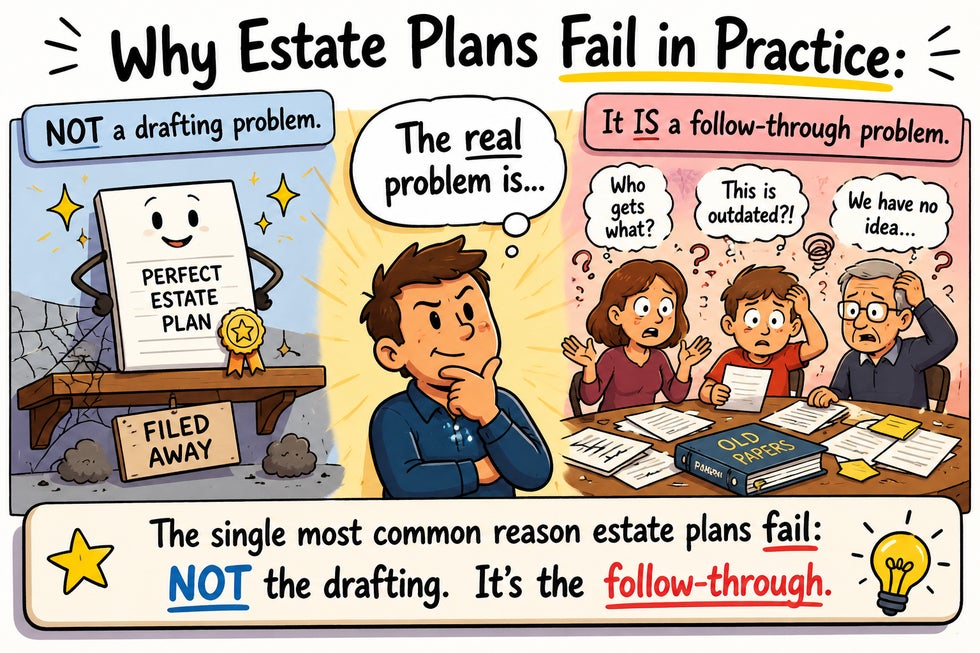
Estate planning has a quiet failure mode that almost no one talks about. The documents are drafted, the binder is delivered, the bill is paid — and then nothing happens. The trust is never “funded.” The deed is never re-recorded into the trust's name. The brokerage account is never retitled. The new baby is never added. The ex-spouse is never removed from the IRA beneficiary form. The family conversation about who gets the house never happens. Years later, on the worst day of the family's life, they discover that the binder on the shelf is a beautiful set of documents that does not actually do what it was supposed to do.
This is the single most common reason estate plans fail in practice. It is not a drafting problem. It is a follow-through problem. And it is the part of planning that the typical document-mill estate practice is structurally unwilling to handle.
What real follow-through looks like
Funding the trust. After the trust is signed, title to your home has to be deeded into the trust's name (a grant deed recorded with the county; this typically does not trigger reassessment under Revenue & Tax Code § 62, but the paperwork has to be done correctly). Brokerage and bank accounts have to be retitled. LLC interests have to be assigned. Vehicles, valuables, business interests, intellectual property — each has its own process. A trust that holds nothing is, legally, an empty container.
Beneficiary designations. Retirement accounts, life insurance, annuities, HSAs, and TOD/POD designations operate independently of your will and trust. They need to be reviewed and updated to match the plan — and re-reviewed after every major life event.
Family conversations. We tell our clients that the kindest thing they can do for their children is to spend an hour at a kitchen table explaining the plan in plain English: who is in charge, where the documents are, what each child can expect, why a particular decision was made. Families that have this conversation rarely end up in court. Families that don't, often do.
Practice succession. For healthcare owners, the plan needs to be coordinated with practice partners (if any), funded with the right amount of life insurance, and revisited when the value of the practice changes. The buy-sell agreement should not be a document signed years ago that no one looks at.
Life changes. Marriage, divorce, the birth or adoption of a child, a child reaching 18, the death of a parent or sibling, the purchase or sale of real estate, the sale of the practice, retirement, a substantial inheritance, a move out of California — each is a planning event. Most clients experience two or three of these in any given decade. None of them update themselves.
Why the relationship matters
Estate-planning attorneys who do this work well do not see you only at signing. They see you on a regular cadence — typically every two to three years for a comprehensive review, plus any time a life event happens. They keep an updated inventory of your assets and how each is titled. They keep your beneficiary designations cross-referenced. They are the person your family will call first when something happens, and they already know your situation when they answer.
|
How We Can Help West Coast Health Law has spent its career serving California healthcare practice owners. We understand the Moscone-Knox rules, the buy-sell mechanics, the way professional corporations actually work in the real world, and what your practice is realistically worth. Our estate-planning division, Coast and Country Estate Law, is built specifically for clients who want planning as a relationship — drafting that is tailored to your family and your practice, full follow-through on funding the trust and updating designations, structured family conversations when you want them, and an ongoing review cadence that catches life changes before they become problems. Schedule a one-hour, no-pressure conversation at lawandbioethics.com or call [phone]. We will quote a flat fee for the package that actually fits, coordinate with your CPA, financial advisor, and (if needed) your insurance broker, and handle every step of funding the trust ourselves — deeds, retitlings, designation forms — so it is actually done, not just promised. |
You worked too hard to build what you have built to let it be sorted out by a default rule, in a courtroom, by strangers! Let us help you write your own plan — and then make sure it does what you want it to.
West Coast Health Law can help you replace California's costly default estate plan. We can help you avoid probate and keep the assets in your families' hands. West Coast Health Law offers a FREE consultation which you may schedule by clicking the button on our website.
Notes & Sources
Educational only — not legal advice. This series is for general information and to help readers understand California estate-planning concepts that affect healthcare practice owners. It does not create an attorney-client relationship and is not a substitute for advice tailored to your specific situation. The case examples are illustrative; the cited cases are public-record matters used here for educational purposes.
Selected California authorities and references:
• California Probate Code §§ 6400 et seq. (intestate succession).
• California Probate Code §§ 10800, 10810 (statutory fees for personal representative and attorney).
• California Probate Code §§ 13100–13116; threshold $208,850 for deaths on or after April 1, 2025 (small-estate affidavit for personal property).
• California Probate Code § 9100 (creditor claims).
• California Corporations Code §§ 13400–13410 (Moscone-Knox Professional Corporation Act; six-month transfer requirement on death of a shareholder).
• California Revenue & Taxation Code § 62 (exclusions from change in ownership — transfers to revocable trusts).
• Case references for illustration only: Estate of Sonny Bono; Estate of Howard Hughes; Marshall v. Marshall (Anna Nicole Smith); Estate of Michael Jackson.

Comments
There are no comments for this post. Be the first and Add your Comment below.
Leave a Comment