
PART 4 · Default vs. Designed: A Side-by-Side
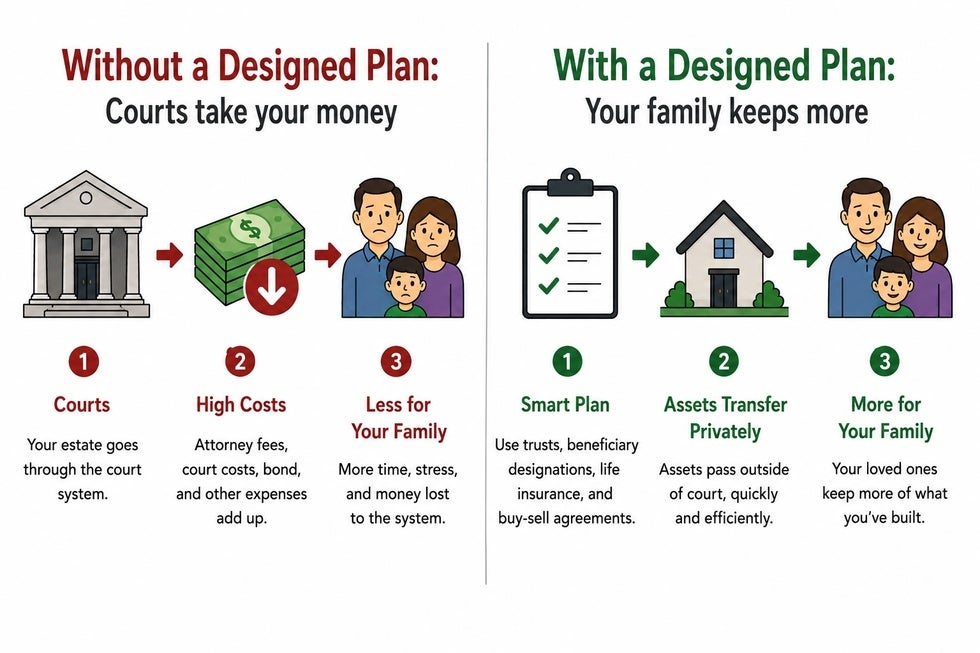
It is one thing to read about probate fees and statutory rules. It is another to see them next to the alternative for the same physician, the same assets, the same family. The table below is drawn from the typical California healthcare practice owner: a married physician in her fifties with two minor children, an established California medical corporation, a primary residence with a mortgage, a rental property, sizeable retirement accounts, a non-retirement brokerage account, and a life insurance policy.
|
Category |
Without a Plan (California Default) |
With a Designed Plan |
|
Medical practice |
Spouse/children cannot legally own the shares. Forced sale within 6 months under Moscone-Knox or risk of revoked corporate registration. Distress pricing common. |
Buy-sell, funded with life insurance, executes automatically. Practice acquired at pre-agreed value; family receives cash. |
|
Primary residence |
Held in individual name. Full probate. 12–18+ months in court. Statutory fees on gross (not net) value. |
Deeded into the revocable living trust. Transfers privately and immediately under trust terms. |
|
Rental property |
Full probate; statutory fees; public inventory. |
Deeded into the trust (or into an LLC owned by the trust). Continues to be managed without interruption. |
|
Brokerage account |
If no beneficiary, full probate. If TOD designation is stale, may go to the wrong person. |
Held in the trust or with current TOD; passes outside probate to the right people. |
|
Retirement accounts |
Pass by beneficiary designation — often stale (ex-spouse, deceased parent, no contingent). Outright distribution to a minor triggers court-appointed guardianship of the estate. |
Reviewed and updated regularly. Trust used as contingent beneficiary where appropriate to protect minors or vulnerable beneficiaries. |
|
Life insurance |
If beneficiary is the estate or none, proceeds enter probate. |
Beneficiary is a person or a trust; pays quickly and outside probate. |
|
Minor children |
No guardian named — court appoints. Children inherit outright at age 18. |
Guardian nominated. Inheritance held in trust to an age the parents choose, with a trusted trustee. |
|
Incapacity (before death) |
No advance directive or power of attorney. Family must petition court for conservatorship — expensive, public, slow. |
Durable POA, healthcare directive, and HIPAA authorizations already in place. |
|
Time to settle |
12 months at the fastest; 18–36 months typical; multi-year if contested. |
Days to weeks for most transfers; months for the full administration. |
|
Cost |
Statutory fees, doubled (executor + attorney), on gross value; plus court, referee, bond, publication, possible extraordinary fees. Often 5–8%; sometimes 10%+. |
Drafting cost upfront; modest ongoing fees for updates. No statutory probate fees. |
|
Privacy |
Public court record. Inventory, debts, beneficiaries, disputes all searchable. |
Private. Trust administration is not public. |
Reading the table is one thing. Adding numbers makes it concrete. On the gross estate above — a $2 million residence, a $750,000 rental, a $1 million practice, $1 million in retirement, $500,000 brokerage, and a $1 million policy on the physician's life paid to the estate — the California gross probate estate could approach $6.25 million. Statutory fees alone (executor + attorney) on $6.25 million run roughly $156,000. Add court filing fees, the probate referee, bond, publication, and possible extraordinary fees, and the all-in number quickly approaches $200,000. None of that goes to the family.
With a designed plan — a trust holding the residence, rental, and brokerage; current beneficiary designations on retirement; the life insurance payable to a trust; a funded buy-sell on the practice — the same family avoids probate entirely. The total cost is the upfront drafting fee, plus modest periodic updates. The savings are not theoretical. They are the difference between the family keeping the assets and the court system extracting a meaningful share of them.
|
A CALIFORNIA CAUTIONARY TALE — MICHAEL JACKSON When Michael Jackson died at his Holmby Hills home in 2009, he had a will and a pour-over trust. That was the good news. The bad news was that his estate was litigated for more than a decade, with disputes over administration, valuation fights with the IRS that reached the U.S. Tax Court, and ongoing beneficiary disputes. The lesson is not that planning doesn't work — it does. The lesson is that the quality of the drafting, the discipline of funding the trust, and ongoing professional follow-through are what determine whether your plan survives contact with reality. |
A point we make carefully, because we know our physician readers do not need a lecture on mortality: the argument for getting estate planning done is not that something dramatic will happen — it is that something dramatic might, and the only window in which you can do anything about it is now, while you can. Sonny Bono was 62 and skiing. The cardiologist who suddenly dies of the condition she treats is not a hypothetical. The driver who runs the red light does not check whether your trust is funded first.
West Coast Health Law can help you replace California's costly default estate plan. We can help you avoid probate and keep the assets in your families' hands. West Coast Health Law offers a FREE consultation which you may schedule by clicking the button on our website.

Comments
There are no comments for this post. Be the first and Add your Comment below.
Leave a Comment