
PART 3 · Your Practice Is Different: The Healthcare Owner Trap
For most California estates, the asset that causes the most heartburn is the home. For a healthcare practice owner, it is almost always the practice. And the rules that govern what happens to your practice if you die without a plan are unique to your profession, surprisingly strict, and rarely understood by general estate planners.
The rule, in one sentence
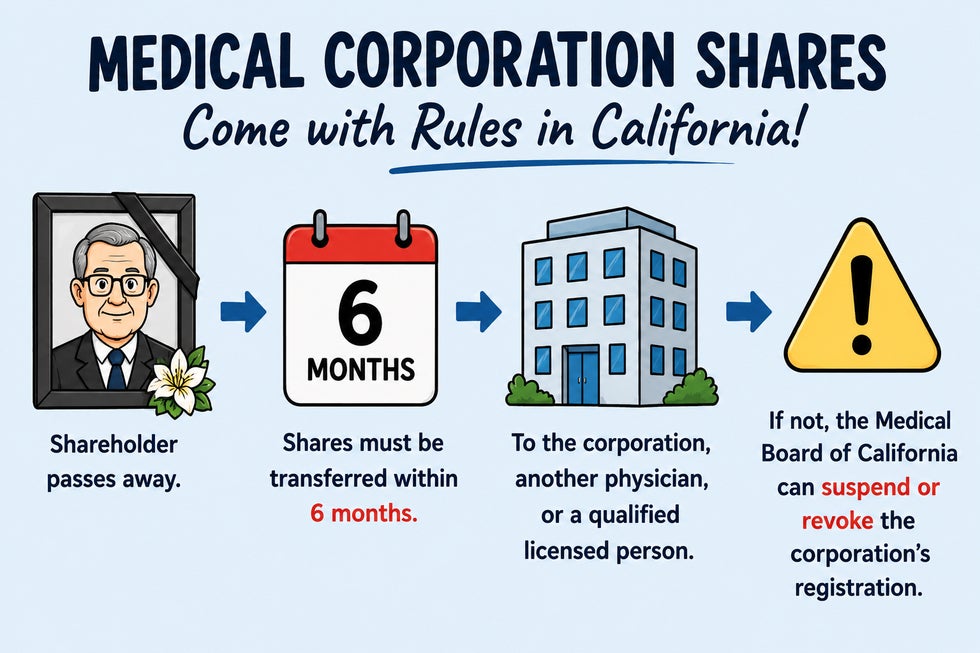
Under California's Moscone-Knox Professional Corporation Act (Corporations Code §§ 13400–13410) and the Medical Practice Act, the shares of a California professional medical corporation may only be owned by California-licensed physicians (and, in some structures, a narrow set of other licensed professionals). If a shareholder dies, the shares must be transferred — to the corporation itself, to another physician-shareholder, or to a qualified licensed person — within six months of the date of death. If that does not happen, the Medical Board of California can suspend or revoke the corporation's certificate of registration.
The practical translation
If you are the sole physician owner of your medical practice and you die without a plan, your spouse and adult children cannot inherit your shares unless they happen to be California-licensed physicians. Your family has six months — while also grieving, while a probate court is being petitioned to appoint an administrator, while patients are calling — to find a buyer, negotiate a purchase price, and close a transaction. Buyers know this. They know your family has no leverage and a calendar. The result, in case after case, is a sale at a fraction of fair value, or no sale at all and a revoked corporation that simply winds down.
The same trap shows up in slightly different forms for other healthcare practice owners — dentists, optometrists, chiropractors, psychologists, physical therapists, nurses with professional corporations. Each profession has its own version of the rule. The common feature is that you cannot solve it after the fact.
What planning can do here
• A buy-sell agreement among shareholders, funded by life insurance, so that on death the corporation (or surviving shareholders) is contractually obligated to buy the deceased physician's shares at an agreed valuation, and has the cash to do so. This is the single most important document most solo and small-group practice owners do not have.
• A “stand-by” arrangement with a trusted licensed physician — sometimes a former colleague — who can step in to maintain the practice or facilitate a sale, with appropriate compensation.
• A revocable living trust that holds non-share assets and the proceeds of the share sale, so the family receives liquidity outside probate.
• Clear, written instructions that comply with the six-month deadline, naming who will execute the plan.
Beyond the practice
Practice owners typically have several other categories of assets that probate handles badly.
Real estate. Real estate held in your individual name — your primary residence, a vacation home, a rental, a medical office building — does not transfer through California's small-estate affidavit, which covers only personal property up to $208,850 (the threshold for deaths on or after April 1, 2025). Real estate triggers full probate or a separate streamlined real-estate procedure that still requires court involvement. The fix is straightforward in advance — deed the property into your living trust — and painful to retrofit later.
Investment and brokerage accounts. Non-retirement investment accounts pass either by the beneficiary designation (TOD/POD) on the account, by trust title, or — if neither is in place — through probate. Many physicians we meet have substantial brokerage accounts with no beneficiary designation at all.
Retirement accounts. IRAs and 401(k)s pass by beneficiary designation, regardless of what your will or trust says. This is where stale designations cause the most pain — an ex-spouse listed as beneficiary, a deceased parent, a minor child with no trust mechanism. The SECURE Act's ten-year payout rule for most non-spouse beneficiaries adds another planning wrinkle.
Life insurance. Pays by beneficiary designation. If the designation is your estate, the proceeds enter probate (and pay statutory fees). If it is a person or a trust, it does not.
|
A CALIFORNIA CAUTIONARY TALE — ANNA NICOLE SMITH Anna Nicole Smith's twenty-year battle over the estate of her late husband, Texas oil tycoon J. Howard Marshall, reached the United States Supreme Court twice (Marshall v. Marshall). The estate was substantial. The documents were ambiguous. The family was blended. The litigation outlasted Smith herself, who died in 2007. Most physician estates are not nine-figure oil fortunes — but blended families, ambiguous documents, and stale designations are universal, and they are exactly the conditions in which probate disasters happen. |
The takeaway for practice owners: Estate planning is not, for you, primarily about a *will*. It is about coordinating a practice succession with a Moscone-Knox–compliant transfer plan, a trust that holds your real estate and investments, current beneficiary designations on retirement and insurance, and a buy-sell with funding. If any one of those is missing, the other three cannot save the family from what comes next.
West Coast Health Law can help you replace California's costly default estate plan. We can help you avoid probate and keep the assets in your families' hands. West Coast Health Law offers a FREE consultation which you may schedule by clicking the button on our website.

Comments
There are no comments for this post. Be the first and Add your Comment below.
Leave a Comment