
When the Practice Closes: How to Wind Down a California Healthcare Practice Responsibly — and What Happens When You Don't
Patient Notification, Records, Regulatory Obligations, and the True Cost of No Plan
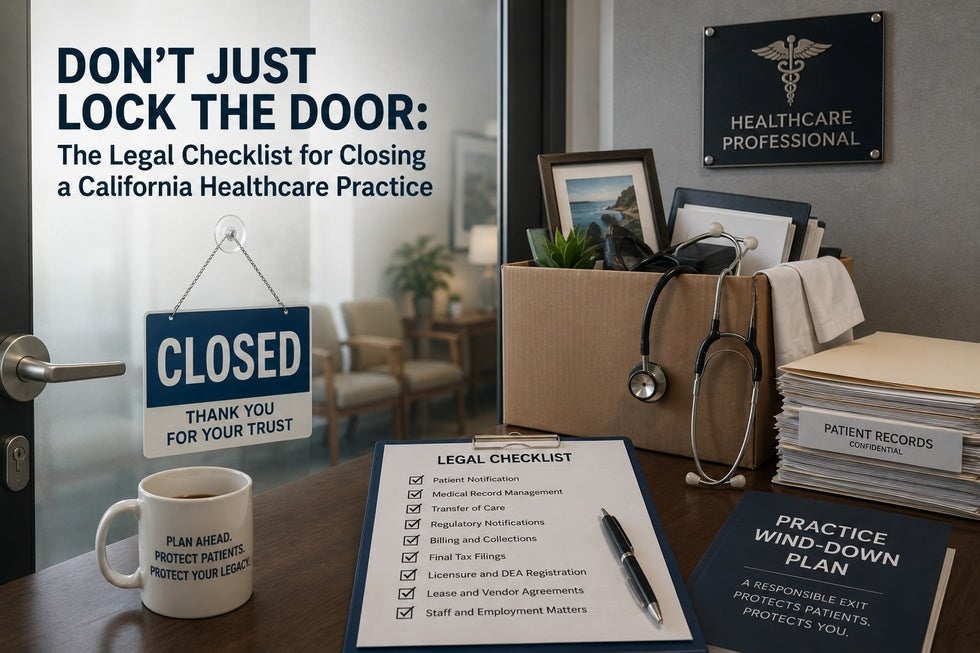
Not every healthcare practice ends in a sale or a partnership transition. Some providers reach the end of their career with no buyer, no associate, and no succession in place. Some are forced to close unexpectedly due to health, family circumstances, or financial pressures. Some simply decide that it is time, and that they would rather close on their own terms than sell.
Closing a California healthcare practice is not simply a matter of turning off the lights and forwarding the mail. It is a regulated event with specific legal obligations to patients, employees, government programs, and licensing boards — and the failure to meet those obligations can follow you far beyond your last day of practice.
This final post walks through the legal requirements for winding down a California healthcare practice, the consequences of getting it wrong, and why even an intentional closure requires as much planning as a sale.
Your Obligations to Patients: The Core of Every Closure
The Medical Board of California is explicit: a physician who closes a practice must notify patients in a manner that prevents patient abandonment. The California Medical Association (CMA) recommends:
• Written notice sent by certified mail, return receipt requested, to all active patients, specifying the final date of care and providing information about how to access or transfer medical records. A copy of each letter and the return receipt should be retained.
• Advance notice sufficient to allow patients to find alternative care. While California law does not specify a single minimum notice period for practice closures (as distinct from the 15-day minimum for terminating an individual patient relationship), the MBC's guidance and the professional standard both strongly favor 30 to 90 days where possible, particularly for patients with chronic conditions or active treatment plans.
• Publication notice in a local newspaper or posting in the reception area, to address inactive patients who may not be reached by direct mail.
• Authorization forms included with the notice letter, to facilitate transfer of records to a new treating physician upon written patient authorization.
Failure to provide adequate notice is not merely an ethical concern — it exposes the closing physician (and their estate, in the event of death) to a finding of patient abandonment, which is a basis for Medical Board discipline under Business and Professions Code Section 2234.
Medical Records: Retention, Custodianship, and Access
Under California Health and Safety Code Section 123100 et seq., patients have a right to access their medical records. That right does not end when you close your practice. Your obligation to preserve and make records available continues for years after the last day of service — and there are serious legal and regulatory consequences for records that are lost, destroyed prematurely, or rendered inaccessible.
Minimum retention requirements:
• Adult patient records: generally seven years from the date of service (California Code of Regulations Title 22, Section 72543; Health and Safety Code Section 123111)
• Minor patient records: at least one year after the patient reaches age 18, but not less than seven years total
• Controlled substance records: at least three years from the date of transaction (Health and Safety Code Sections 11190 and 11191)
• Employee medical records involving toxic substance exposure: the duration of employment plus 30 years (California Code of Regulations Section 3204(d))
Medical records custodianship: Closing providers who do not intend to maintain records personally should engage a professional medical records custodian — a third-party service that stores and fulfills patient record requests according to applicable retention requirements. The identity and contact information of the custodian must be communicated to patients in the closure notice.
Regulatory Notifications That Cannot Be Skipped
Closing a California healthcare practice involves notifications to a number of agencies and entities, not all of which are obvious. These include:
Medical Board of California — notify the Board of the closure or change in practice status.
Drug Enforcement Administration (DEA) — a retiring physician must send written notice to the local DEA Diversion Field Office, request retirement of the DEA Certificate of Registration, and return DEA Form 222 order forms. Failure to properly surrender DEA registration has resulted in enforcement consequences for physicians who assumed inactivity was sufficient.
Medicare and Medi-Cal — provide timely notice of participation changes. Medicare and Medi-Cal overpayments are a significant source of post-closure financial liability. A closing practice should conduct a billing audit before closure and address any known overpayment obligations proactively. Failure to do so may result in recoupment actions against the estate.
Health plans and payer networks — each commercial payer in which the practice participates must be notified. This is typically required by the payer contract and failure to provide timely notice can result in claims for the return of capitation payments or pre-paid amounts.
Professional liability carrier — contact your malpractice carrier immediately. Request tail coverage, which protects you against claims arising from care provided before closure but not filed until after it. As noted by Simas & Associates and other healthcare practice consultants, many carriers provide free or discounted tail coverage for physicians who have maintained coverage with the carrier for a minimum period. The purchase and sale agreement (in a sale scenario) should specify which party bears the tail coverage cost.
Landlord — review the practice lease for notice requirements, termination provisions, and personal guarantee obligations. Landlords frequently hold physician lessees personally liable under practice leases. Early notice allows for negotiation of a lease buyout rather than a default.
Equipment lessors and vendors — notify all equipment lessors, software vendors, EHR providers, and suppliers of the closure date and coordinate the termination of agreements without incurring unnecessary post-closure charges.
Staff Obligations: Employment Law Does Not Pause for Closure
Your obligations to employees do not end when you decide to close — in some respects, they become more urgent.
Notice requirements: If you have 25 or more employees (California WARN Act, Labor Code Section 1400 et seq.) or 100 or more employees (federal WARN Act), advance notice of a mass layoff or closure may be required — up to 60 days under the federal law, and 60 days under California's law, which applies a lower employee threshold than the federal standard.
Even for practices below these thresholds, California best practices — and basic employment law ethics — call for as much advance notice as operationally feasible.
Final paychecks: Under California Labor Code Section 201, employees who are laid off or terminated must receive their final paychecks immediately at the time of termination. This obligation is absolute and does not depend on the financial condition of the practice. Failure to pay final wages on time triggers waiting time penalties of one day's wages per day of delay, up to 30 days (Labor Code Section 203). These penalties apply even if the physician is closing because of financial distress.
COBRA notification: Employees must be notified of their COBRA continuation rights for group health coverage.
The Professional Corporation: Dissolution Is Not Automatic
If your practice was operated through a California professional medical corporation, the corporation does not dissolve automatically when you stop seeing patients. You must affirmatively dissolve it under California Corporations Code Sections 1900 et seq., which involves:
• Filing a Certificate of Dissolution with the California Secretary of State
• Filing a Certificate of Election to Wind Up and Dissolve if directors and shareholders approve
• Settling all corporate debts and liabilities before distribution of remaining assets
• Filing final tax returns with the California Franchise Tax Board
An abandoned professional corporation — one that is simply left dormant — continues to accumulate California minimum franchise tax obligations and may be subject to suspension by the Franchise Tax Board, creating additional complications.
The True Cost of No Plan: A California Case Study in Consequences
Consider what happens when a solo California physician dies with no succession plan, no buy-sell agreement, and no patient notification protocol in place:
• The practice closes immediately, because there is no licensed provider to continue clinical care.
• Patients with active prescriptions, pending referrals, and scheduled procedures receive no notice and have nowhere to turn.
• Staff receive no notice and must be terminated immediately, triggering final paycheck obligations and potential WARN Act liability, all of which fall on the estate.
• The estate of the physician — often administered by a surviving spouse with no medical or business background — is suddenly responsible for months of lease obligations, equipment lease payments, EHR subscription fees, malpractice tail coverage, DEA surrender, payer notifications, medical records retention, and patient abandonment complaints to the Medical Board.
• A practice that had value — perhaps significant value — as a going concern is now worthless. The goodwill, the payer contracts, the equipment, and the patient relationships that could have been sold or transitioned are gone.
• The estate, which the physician believed was providing for their family, is instead consumed by the cost of an unplanned closure.
This is not a hypothetical. It is the outcome that healthcare attorneys and practice management consultants document with regularity across California every year.
Benefits and Drawbacks of a Planned Closure vs. No Plan
|
Planned Closure |
No Plan / Sudden Closure |
|
|
Patient outcomes |
Orderly transition; abandonment avoided |
Abandonment risk; Board discipline exposure |
|
Staff |
Advance notice; compliant final pay |
Immediate termination; wage claim exposure |
|
Payer obligations |
Timely notice; audit before closure |
Recoupment actions with no one to respond |
|
Records |
Custodian engaged; access preserved |
Records at risk; privacy liability |
|
Estate value |
Tail coverage secured; leases negotiated |
Liabilities consume estate; practice value lost |
|
Regulatory standing |
Board and DEA closure properly documented |
Discipline risk survives provider death |
|
Family impact |
Manageable and dignified |
Chaotic and financially devastating |
Final Thoughts: The Practice You Built Deserves a Plan
You did not build your practice carelessly. You did not treat patients carelessly. You did not hire your staff carelessly. Do not leave the end of your practice to chance.
Every California healthcare provider — solo practitioner or partnership, physician or dentist, psychiatrist or chiropractor — has an obligation that goes beyond their license. It is an obligation to the patients who trusted them, the staff who depended on them, the families who relied on the practice's income, and the referral partners who built their networks around them.
Not planning is not a neutral choice. It is the choice that leaves everyone else to pay the price.
West Coast Health Law: Your Partner in Practice Succession
Whether you are years from retirement and thinking about your options, or you are facing an unexpected health event and need immediate guidance, West Coast Health Law is here to help.
We advise California healthcare providers across every stage of the succession planning process:
• Practice sales — structuring compliant asset or stock transactions, drafting purchase agreements, managing patient notification and records obligations
• Internal succession — buy-sell agreements, shareholder structures, associate-to-partner transitions, funding arrangements
• Continuity planning — durable powers of attorney, locum tenens protocols, MSO and continuity agreement structures, coordination with estate and financial planners
• Practice closure — regulatory notifications, records custodianship, employment law compliance, corporate dissolution
Your patients, your staff, your referral partners, and your family deserve to know that there is a plan. We help you build one.
|
Contact West Coast Health Law today. Even though the best time to start was years ago, the second-best time is now. West Coast Health Law offers a FREE consultation which you may schedule by clicking the button on our website. |
Key California Law Referenced in This Post:
Business and Professions Code §§ 2234 (patient abandonment/discipline), 2026 (patient notice);
California Health and Safety Code §§ 123100 et seq. (patient records access), 11190, 11191 (controlled substance records);
California Code of Regulations Title 22, § 72543 (medical records retention), § 3204(d) (employee records);
California Labor Code §§ 201, 203 (final paycheck and waiting time penalties), §§ 1400 et seq. (California WARN Act);
Corporations Code §§ 1900 et seq. (corporate dissolution);
Federal WARN Act, 29 U.S.C. § 2101 et seq.;
Medical Board of California Practice Closure Guidance;
California Medical Association Records Retention and Closure Guidelines;
DEA Diversion Control Division Practitioner Registration Requirements
|
Important Disclaimer: This post is for general informational purposes only and does not constitute legal advice. Reading this post, visiting our website, clicking a scheduling button, or requesting a consultation does not create an attorney-client relationship with West Coast Health Law Group. An attorney-client relationship is formed only after we confirm there is no conflict of interest and both you and our firm sign a written engagement agreement. If you are a California healthcare provider considering a partnership or internal succession arrangement, we invite you to schedule a free consultation through the button on our website to see whether we may be a good fit to help. |

Comments
There are no comments for this post. Be the first and Add your Comment below.
Leave a Comment