
BUYING A MEDICAL PRACTICE IN CALIFORNIA — PART 2 OF 4
The Legal Rules That Govern Your Purchase
Corporate practice of medicine, ownership limits, the 2026 restrictions, and what does not transfer.
Series: Part 1: The Framework | Part 2: The Legal Rules | Part 3: Common Mistakes | Part 4: Practical Implementation
Part 1 introduced the framework: who may own a California medical practice, the asset-versus-stock choice, and where outside capital fits. This article goes a level deeper into the legal rules that make California distinctive. These are not technicalities you can clean up after closing—they determine whether your purchase is valid at all.
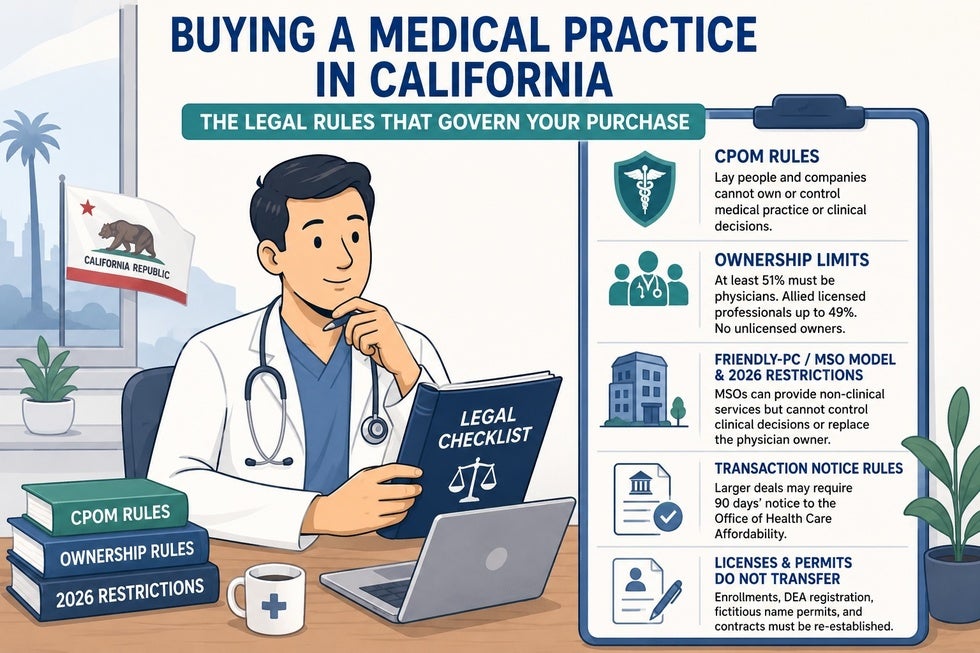
1. The Corporate Practice of Medicine doctrine
California's prohibition on the corporate practice of medicine flows from the Business and Professions Code and decades of Medical Board guidance. The rule bars unlicensed persons and lay-owned entities from owning a medical practice, employing physicians to practice medicine, or controlling clinical decision-making. The Medical Board treats a long list of decisions as inherently clinical and therefore off-limits to lay control, including determining what diagnostic tests are needed, deciding on referrals, setting the number of patients a physician sees, and overriding a physician's clinical judgment.
For a buyer, CPOM is the gatekeeper: it dictates that the acquiring party be a licensed physician or a qualifying professional medical corporation. Structuring around it improperly—for example, having a lay-owned company “buy” the practice and merely contract a physician to be the face of it—risks the entire arrangement being unwound.
2. Who may own a professional medical corporation
California medical practices that operate as corporations must be professional medical corporations formed under the Moscone-Knox Professional Corporation Act. Ownership is restricted by both a percentage and a headcount rule:
• At least 51% of the shares must be owned by California-licensed physicians (M.D.s or D.O.s).
• A defined set of allied licensed professionals—such as podiatrists, psychologists, registered nurses, physician assistants, optometrists, chiropractors, and licensed clinical social workers—may collectively own up to 49%, and their number may not exceed the number of physician shareholders.
• Unlicensed individuals and lay investors may own no shares at all in the professional corporation.
If you are buying through a professional corporation, confirm that your ownership and that of any co-investors fits inside these limits before you sign. A cap-table that violates Moscone-Knox cannot be fixed with a side letter.
3. The friendly-PC / MSO model and the 2026 restrictions
Because lay investors cannot own the PC, outside capital is channeled through a management services organization that contracts with the physician-owned PC. The MSO can own equipment and real estate, employ administrative staff, and provide management services for a fair-market fee. What it cannot do is control medicine.
Two California laws enacted in 2025 and effective January 1, 2026—Senate Bill 351 and Assembly Bill 1415—codified and tightened this boundary. SB 351 expressly prohibits private-equity groups, hedge funds, and MSOs from controlling or unduly influencing the clinical decisions of physician and dental practices, tracking the Medical Board's list of protected clinical judgments. The California Attorney General has separately taken a hard line on MSO agreements that give a lay company the right to replace the PC's physician-owner with a doctor of its choosing, viewing that as impermissible control over a “captive” practice. If your deal involves an MSO, the management agreement's terms on clinical control, owner-succession, and termination deserve close legal review.
4. California's health care transaction notice rules
Larger deals may trigger a state notice requirement. The Office of Health Care Affordability (OHCA) administers a pre-transaction “material change” notice process, generally requiring 90 days' advance notice for qualifying transactions that meet financial thresholds (broadly, parties or targets with roughly $25 million or more in California revenue or assets, with a lower $10 million trigger in some cases). AB 1415, effective in 2026, expanded who must give notice to include private-equity groups, hedge funds, and MSOs, with implementing regulations being finalized. Most single-physician practice purchases fall below these thresholds, but platform and roll-up buyers should screen every deal against them early.
5. Licenses and permits do not travel with the practice
Even a lawful purchase does not automatically transfer the credentials needed to operate. As a rule, the following are tied to a specific provider or entity and must be obtained or updated rather than inherited:
• Medicare and Medi-Cal provider enrollments generally do not transfer; the buyer typically must enroll and complete a CMS reassignment of benefits.
• DEA registrations are issued per registrant and location and must be re-established.
• A fictitious name permit from the Medical Board is required to practice under a business name, and that name must include a designation such as “medical group,” “medical corporation,” or “medical clinic.”
• Commercial payor contracts often require consent to assignment or fresh credentialing, and a CLIA certificate is needed if the practice runs a laboratory.
Part 3 shows how overlooking these rules turns into expensive, deal-threatening mistakes—and how careful buyers avoid them.
This article is provided for general informational purposes only and does not constitute legal advice or create an attorney–client relationship. California law in this area is evolving; statutes and regulatory guidance referenced here were current as of the date of writing. Consult qualified healthcare counsel before acting on any transaction.
West Coast Health Law offers a FREE consultation which you may schedule by clicking the button on our website.

Comments
There are no comments for this post. Be the first and Add your Comment below.
Leave a Comment