
BUYING A MEDICAL PRACTICE IN CALIFORNIA — PART 1 OF 4
The Framework: How Medical Practice Purchases Work in California
Before price or paperwork, understand who can own a practice and how these deals are built.
Series: Part 1: The Framework | Part 2: The Legal Rules | Part 3: Common Mistakes | Part 4: Practical Implementation
Buying a medical practice in California is not like buying any other business. The same transaction that would be routine for a restaurant or a software company runs into a wall of healthcare-specific rules the moment a physician is involved. Before you ever discuss price, you need a mental map of how these deals are structured—and why California, in particular, places the practice of medicine at the center of every decision.
Who is actually allowed to own the practice
The single most important concept in California is the Corporate Practice of Medicine doctrine, often shortened to CPOM. In plain terms, a business owned by non-physicians cannot practice medicine, and it cannot employ physicians for the purpose of practicing medicine. Clinical judgment is reserved for licensed clinicians, not for lay owners whose financial incentives might pull against patient welfare.
The practical consequence for a buyer is simple but far-reaching: the entity that acquires a medical practice generally must itself be authorized to practice medicine. That usually means you are buying as an individual licensed physician or, more commonly, through a California professional medical corporation that you own and control. A general LLC or an ordinary corporation owned by investors cannot simply purchase the practice and start treating patients.
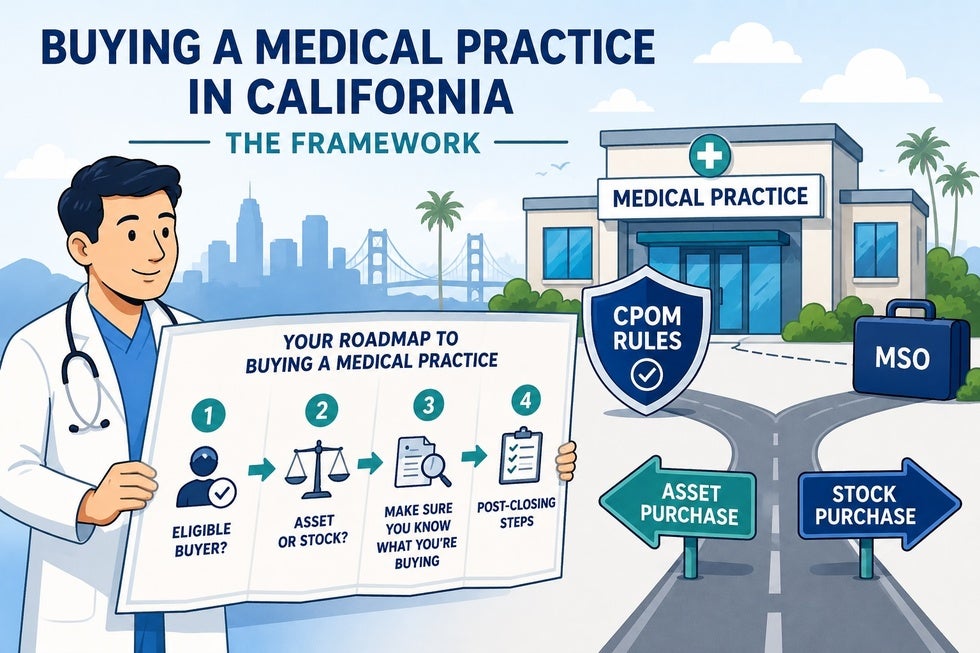
The two ways to structure the deal
Almost every practice purchase takes one of two forms, and the choice colors everything that follows.
• Asset purchase. You form (or use) your own professional corporation and buy selected assets of the seller—equipment, the patient list, goodwill, the lease, and certain contracts—while leaving the seller's legal entity, and most of its history, behind. This is the more common structure for smaller practices because it lets the buyer leave unknown liabilities with the seller.
• Stock (equity) purchase. You buy the shares of the seller's professional corporation itself, stepping into the existing entity with all of its contracts and provider numbers—and all of its liabilities, known and unknown. Because the buyer of shares in a medical corporation must be eligible to own those shares, this route is only available to physicians who qualify under California's ownership rules.
Neither structure is inherently better. Asset deals give you a clean start but require re-papering leases, payor contracts, and enrollments. Stock deals preserve continuity but demand far deeper diligence. Part 3 returns to the traps in each.
Where non-physician money fits in
Many buyers are not solo physicians writing a personal check. They are management companies, investor groups, or multi-site platforms that want to grow. California accommodates outside capital, but only through a specific arrangement: the friendly-PC plus MSO model. A physician-owned professional corporation delivers the clinical care, while a separately owned management services organization (MSO) provides the non-clinical infrastructure—billing, staffing, real estate, IT—under a management services agreement.
This structure is legitimate and widely used, but it is under intensifying scrutiny in California. Recent legislation effective January 1, 2026 sharpened the line between permissible business support and impermissible control over clinical decisions, and the California Attorney General has publicly questioned arrangements that let a lay company swap out a practice's physician owner at will. If outside investment is part of your plan, the friendly-PC/MSO design has to be built carefully from day one. Part 2 covers the rules in detail.
The four questions every buyer should answer first
Before drafting a letter of intent, a disciplined buyer can answer four threshold questions. They organize the rest of this series.
• Am I an eligible buyer? Are you, or is your professional corporation, legally able to own a California medical practice?
• Asset or stock? Which structure fits the practice's contracts, payor mix, and liability profile?
• What am I really buying? Goodwill and patients, or also licenses, provider numbers, and contracts that may not transfer?
• What has to happen after closing? Which permits, enrollments, and registrations must be re-established before you can lawfully bill and treat?
What comes next in this series
With the framework in place, the next article unpacks the specific legal rules that govern eligibility and structure—the Corporate Practice of Medicine doctrine, the Moscone-Knox ownership requirements, the 2026 restrictions on private-equity involvement, and California's transaction-notice regime. From there we turn to the mistakes that derail deals, and finally to a practical, sequenced plan for getting from handshake to a fully operational practice you own and control.
This article is provided for general informational purposes only and does not constitute legal advice or create an attorney–client relationship. California law in this area is evolving; statutes and regulatory guidance referenced here were current as of the date of writing. Consult qualified healthcare counsel before acting on any transaction.
West Coast Health Law offers a FREE consultation which you may schedule by clicking the button on our website.

Comments
There are no comments for this post. Be the first and Add your Comment below.
Leave a Comment