
BUYING A MEDICAL PRACTICE IN CALIFORNIA — PART 3 OF 4
Common Mistakes Buyers Make — and How to Avoid Them
Seven recurring errors that delay closings, raise costs, or unwind deals.
Series: Part 1: The Framework | Part 2: The Legal Rules | Part 3: Common Mistakes | Part 4: Practical Implementation
Parts 1 and 2 covered how these deals are structured and the rules that govern them. Knowing the rules is not the same as applying them under deadline pressure, with a motivated seller and a financing clock running. The mistakes below are the ones healthcare buyers in California make again and again. Each maps back to a principle from the earlier articles.
Mistake 1: Using the wrong buying entity
Buyers eager to involve investors sometimes try to acquire a practice through an ordinary LLC or an investor-owned corporation. Under the Corporate Practice of Medicine doctrine, that entity cannot lawfully own a medical practice or employ physicians to practice. The fix is to put the clinical acquisition in a properly formed professional medical corporation and route any non-physician capital through a compliant MSO. Sorting this out after a letter of intent is signed wastes weeks and legal fees; sorting it out after closing can invalidate the deal.
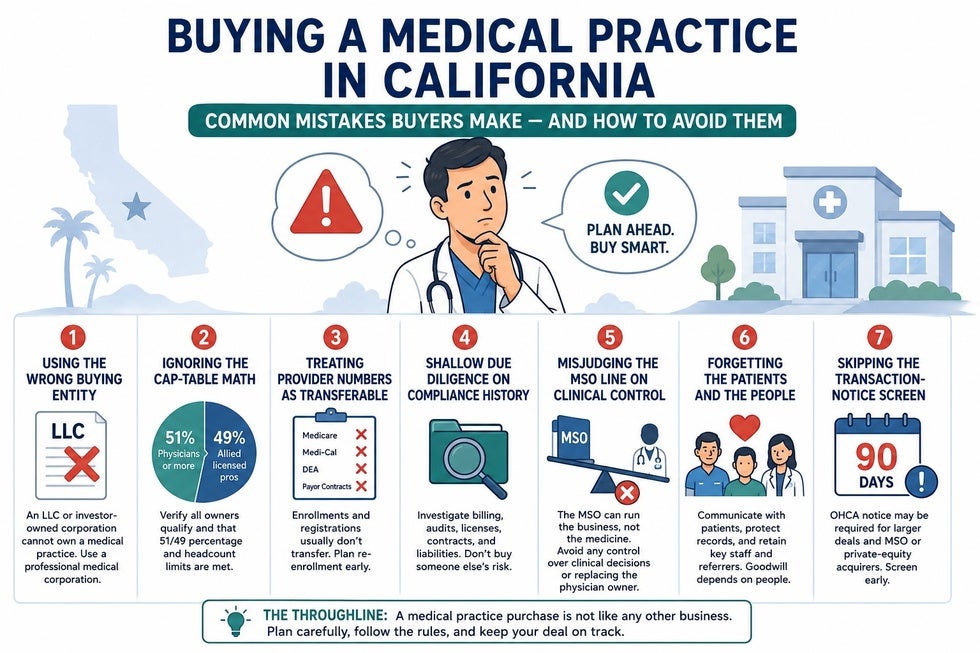
Mistake 2: Ignoring the cap-table math
The Moscone-Knox rules are unforgiving. A practice where a non-physician spouse, a retired partner who has let a license lapse, or an allied professional holds too large a stake is out of compliance—regardless of good intentions. Buyers who fail to verify the seller's ownership inherit that problem, and buyers who build their own non-compliant cap-table create a fresh one. Confirm, in writing, that every shareholder qualifies and that the 51/49 percentage and headcount limits hold both before and after the sale.
Mistake 3: Treating provider numbers as transferable
This is the most common operational shock. Buyers assume that when they acquire the practice, the Medicare and Medi-Cal enrollments, the DEA registration, and the payor contracts come along for the ride. In an asset deal they generally do not, and even in a stock deal they may require notice or re-credentialing. The result of assuming otherwise is a practice that cannot bill on day one—sometimes for months—while enrollment applications sit in a queue. Build re-enrollment into the timeline before closing, not after.
Mistake 4: Shallow due diligence on compliance history
Especially in a stock purchase, the buyer steps into the seller's past. That past can include improper coding and billing, unreturned overpayments, lapsed HIPAA safeguards, malpractice exposure, or arrangements that implicate federal and California fraud-and-abuse laws. None of these are visible on a balance sheet. Diligence has to reach licenses and board certifications, billing and coding samples, payor audit history, controlled-substance protocols, employment and contractor agreements, and the assignability of leases and vendor contracts. A discounted price is no bargain if it comes with a regulatory liability.
Mistake 5: Misjudging the MSO line on clinical control
For investor-backed buyers, the most dangerous mistake in 2026 is drafting a management services agreement that crosses into clinical control. Provisions that let the MSO dictate staffing ratios, override clinical judgment, or—per the Attorney General's recent guidance—replace the physician owner at the company's discretion now sit squarely in the crosshairs of SB 351 and the AG's enforcement posture. The MSO can run the business; it cannot run the medicine. Have healthcare counsel pressure-test the agreement against the new statutes.
Mistake 6: Forgetting the patients and the people
Legal compliance is necessary but not sufficient. Deals stumble when buyers neglect the human side: proper notice to patients about the change in ownership and how to obtain or transfer their records, custody and retention of medical records consistent with California requirements, and retention of key staff and referring relationships that make the goodwill real. A practice is its patients and its team; lose them in the transition and you have bought an empty shell.
Mistake 7: Skipping the transaction-notice screen
Platform and roll-up buyers sometimes overlook California's OHCA material-change notice requirement, which can demand 90 days' advance notice for qualifying transactions and, since 2026, reaches private-equity, hedge-fund, and MSO acquirers. Discovering a notice obligation late can delay a closing by a full quarter. Screen every deal against the thresholds at the letter-of-intent stage.
The throughline. Almost every mistake here comes from treating a medical practice purchase like an ordinary business acquisition. It is not. The final article turns these cautions into an affirmative plan—a sequence of steps that keeps a deal compliant and on schedule from first contact to first patient.
This article is provided for general informational purposes only and does not constitute legal advice or create an attorney–client relationship. California law in this area is evolving; statutes and regulatory guidance referenced here were current as of the date of writing. Consult qualified healthcare counsel before acting on any transaction.
West Coast Health Law offers a FREE consultation which you may schedule by clicking the button on our website.

Comments
There are no comments for this post. Be the first and Add your Comment below.
Leave a Comment