
Part 3: So Should You Hang Your Own Shingle? A Practical Launch Guide for 104 NPs
Part 3 of a 3-part series on independent nurse practitioner practice in California.
Parts 1 and 2 covered the law: 104 NP certification lets a qualified nurse practitioner practice independently, and a nursing corporation lets that NP own the practice outright — provided they stay within their certification scope, respect the Corporate Practice of Medicine doctrine, and present the practice honestly as a nursing practice. This final part is the practical one. Can you start your own practice based on 104? What relationship with a physician do you still need? And what does a compliant launch actually look like?
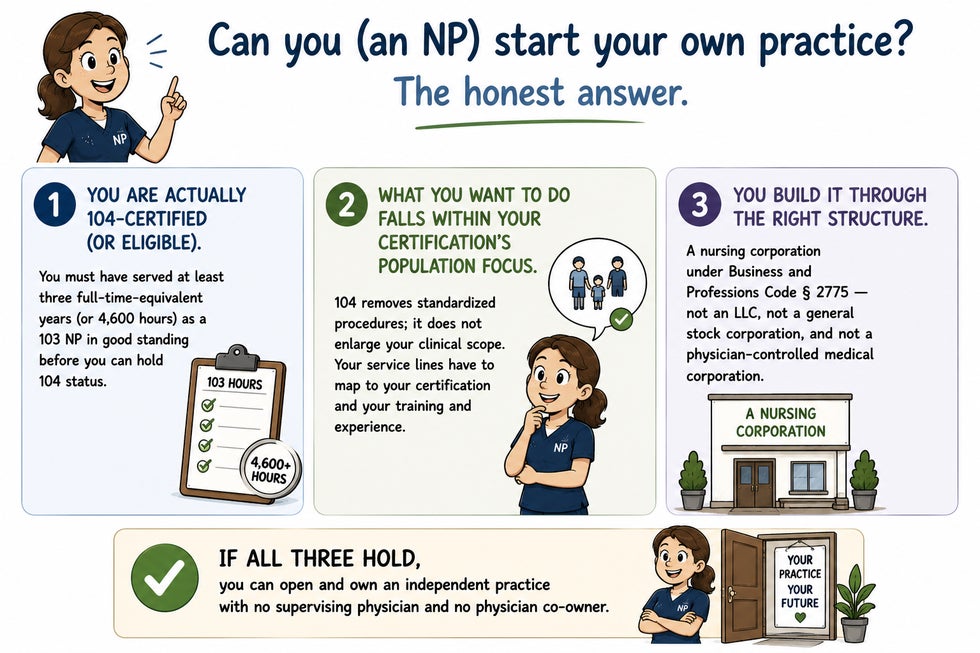
Can you start your own practice? The honest answer.
Yes — if three things are true:
1. You are actually 104-certified (or eligible). You must have served at least three full-time-equivalent years (or 4,600 hours) as a 103 NP in good standing before you can hold 104 status (16 CCR § 1482.4). If you are not there yet, your near-term path is to log qualifying 103 hours and document them carefully, not to form an entity prematurely.
2. What you want to do falls within your certification's population focus. 104 removes standardized procedures; it does not enlarge your clinical scope. Your service lines have to map to your national certification and your genuine training and experience.
3. You build it through the right structure. A nursing corporation under Business and Professions Code § 2775 — not an LLC, not a general stock corporation, and not a physician-controlled medical corporation.
If all three hold, you can open and own an independent practice with no supervising physician and no physician co-owner.
What relationship with a physician do you actually need?
This is the question almost every NP asks, and the answer has two distinct layers that are easy to conflate.
For ownership and supervision: none is required. A 104 NP does not need a supervising physician, a medical director, or a physician shareholder to own and operate an independent practice within their scope. The “51% physician” rule belongs to medical corporations and simply does not apply to your nursing corporation.
For clinical care: a relationship is still legally required — just not an ownership or supervision one. Section 2837.104(c) requires every 104 NP to consult, collaborate, and refer to physicians and other healing-arts providers based on the patient's clinical condition. Concretely, the statute and regulations contemplate that you will:
• Consult a physician for emergent conditions that require prompt medical intervention, after you have started initial stabilizing care.
• Maintain a written referral plan specific to your practice area, with clear criteria for referring complex cases and emergencies to a physician or other appropriate provider.
• Refer and collaborate whenever a patient's needs fall outside your competence or certification.
Note the distinction the statute draws: consulting a physician under these provisions does not create a physician-patient relationship, and you remain solely responsible for the care you provide. So the physician relationship you need is a clinical safety net — referral and consultation arrangements — not a boss and not a business partner.
One practical exception to flag: if your service lines include procedures that themselves constitute the practice of medicine or require physician involvement (for example, certain aesthetic/med-spa procedures, or anything beyond your nursing scope), you may still need a physician — a medical director or a separate compliant structure — for those services specifically. That is a scope-of-procedure question, separate from the question of whether you can own your practice. When in doubt, map each planned service against your certification before you offer it.
A compliant launch, step by step
Think of this as the sequence, not a single afternoon's paperwork.
1. Confirm and document 104 eligibility. Verify your 103 hours/years in good standing and submit the 104 application through the Board of Registered Nursing (BreEZe). Don't sign a lease or commit capital before your certification is real.
2. Form a nursing corporation. Incorporate under the Moscone-Knox Act with RN/NP ownership, satisfy the nursing-corporation naming requirements (it must read as a nursing corporation, not a medical one), adopt bylaws, issue shares to eligible licensees, and register as required. Have counsel confirm the entity and name will pass muster.
3. Stand up your prescribing authority. Ensure your furnishing/prescribing authority is in order without standardized procedures, obtain a DEA registration if you'll prescribe controlled substances, and enroll in CURES.
4. Get credentialed and enrolled with payors. A 104 NP can contract directly with commercial and government payors. Budget months for credentialing and enrollment. Be aware of the current limits on risk-bearing/capitation arrangements discussed in Part 2.
5. Build your clinical safety net. Put your § 2837.104(c) referral plan in writing, and line up consultation and referral relationships with physicians and specialists before you see your first patient — not after an emergency.
6. Handle HIPAA and compliance. If you bill third-party payors, implement HIPAA Privacy and Security compliance: a notice of privacy practices, business associate agreements, and reasonable safeguards.
7. Post and deliver your patient disclosures. Display the required 48-point Board of Registered Nursing notice, and verbally inform new patients that a nurse practitioner is not a physician and surgeon. Align all marketing with these disclosures.
8. Get your advertising right. Market as a nurse practitioner and a nursing practice. Do not use “M.D.” or “D.O.,” do not call the entity a medical corporation or medical group, and do not imply you are a physician.
9. Mind the employment and tax obligations. As an employer you take on California's wage-and-hour, classification, and workplace requirements, plus ordinary business licensing, insurance (including professional liability), and tax setup.
10. Be careful with outside money. If you bring in an MSO or investors, structure it to avoid fee-splitting and corporate-practice problems, and watch the still-unsettled application of transaction-notice and private-equity rules to 104 NP practices.
A quick gut check before you commit
Independence is a business, not just a license. Beyond the legal boxes, ask yourself: Do you have the patient base or referral pipeline to fill a panel? The capital to survive the credentialing lag before payments arrive? The appetite to run payroll, compliance, and operations — or the budget to delegate them? 104 makes ownership legal; these questions decide whether it's viable.
The bottom line for the series
California's 104 NP framework is a real and significant expansion of nurse practitioner independence. A qualified 104 NP can own and operate an independent practice with no supervising or owning physician. But that independence lives inside firm guardrails: you must use a nursing corporation, stay within your certification's scope, maintain physician consultation and referral relationships for clinical safety, present yourself accurately as a nurse practitioner rather than a physician, and comply with the web of corporate, prescribing, privacy, and employment rules that apply to any clinical business.
Done thoughtfully, with the structure built right from day one, it is a genuine path to practice ownership. Done on assumptions and headlines, it is an enforcement risk. The difference is planning — ideally with a California health care attorney — before you open the door.
West Coast Health Law offers a FREE consultation which you may schedule by clicking the button on our website.
This article is for general educational purposes and is not legal advice and does not create an attorney-client relationship. The 104 NP framework is new and several adjacent rules remain unsettled. Your situation — your certification, services, financing, and location — drives the analysis. Consult a qualified California health care attorney before launching.
Key authorities: Cal. Bus. & Prof. Code §§ 2775, 2837.103, 2837.104; 16 CCR § 1482.4; Cal. Corp. Code §§ 13400–13410, 13401.5; California Board of Registered Nursing, AB 890 resources (rn.ca.gov/practice/ab890.shtml).

Comments
There are no comments for this post. Be the first and Add your Comment below.
Leave a Comment